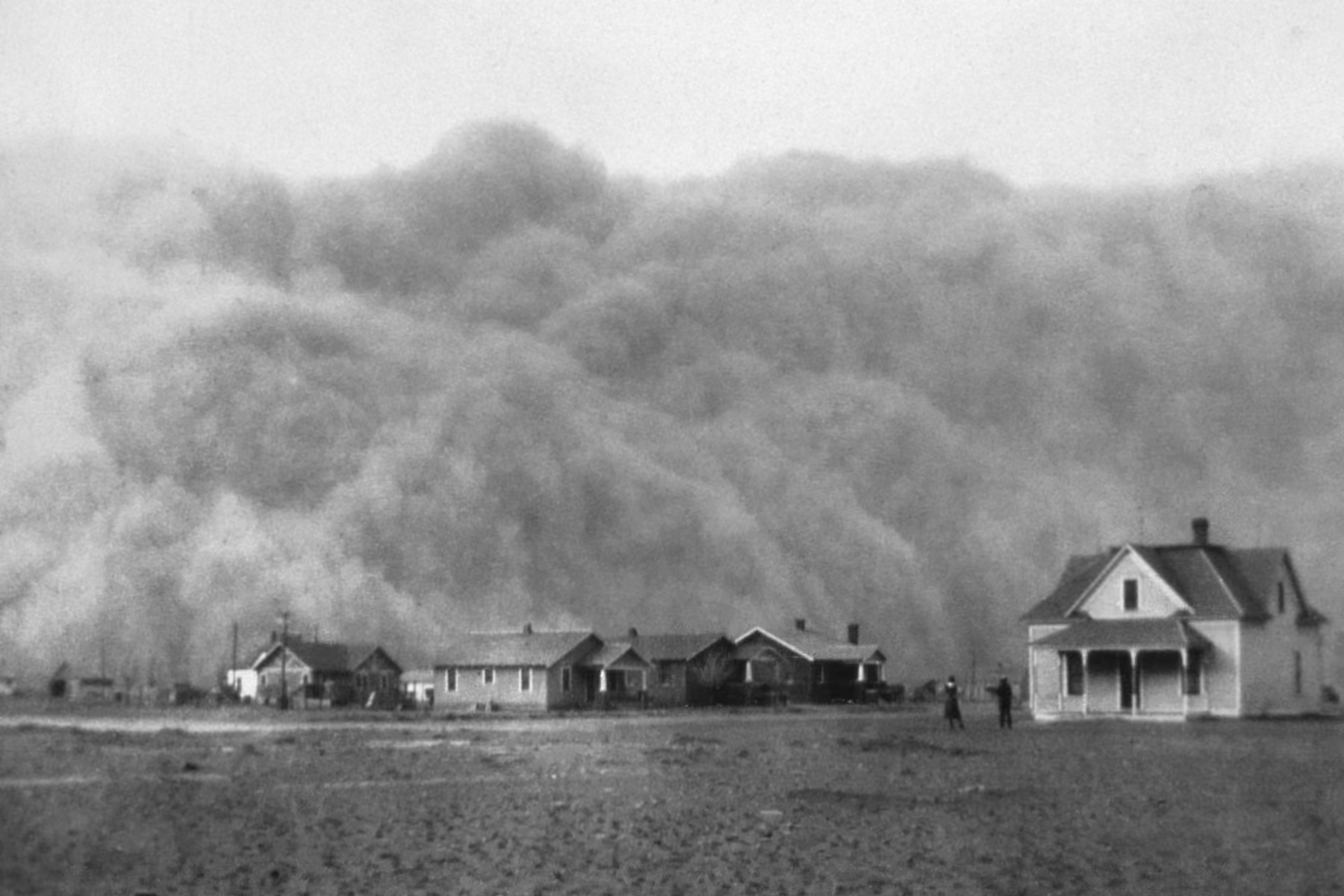
The first thing to understand about the photograph is that the dark mass is not cloud. It is topsoil, lifted off ploughed ground by wind and carried at the height of weather.
The second is the scale. The farmhouse at the right gives it: the front of the storm is several times the height of the building and still some distance away.
Why the front has that shape
A dust front behaves like a density current. Air carrying suspended soil is heavier than the air ahead of it, so it advances along the ground, rolls forward at its leading edge and lifts into a curved face.
The same physics produces the leading edge of a thunderstorm outflow. What is unusual here is the material: not water droplets but the ground itself, and the reason the ground was available to lift was that it had been broken and left bare.
What the picture did
Photographs of this kind travelled. They were reproduced in newspapers far from the plains and gave a distant public a single image to attach to a set of policies, migrations and failures that were otherwise statistical.
A picture cannot make an argument on its own. What it can do is make an argument unavoidable, and this one did that for a landscape most of its viewers would never see.
It remains in the public domain, which is why it is still doing the work.