A dune is not a pile. It is a machine that moves grains uphill on its windward side and drops them down the steeper face behind, and in doing so it travels — slowly, but in a direction, and at a rate that can be measured.
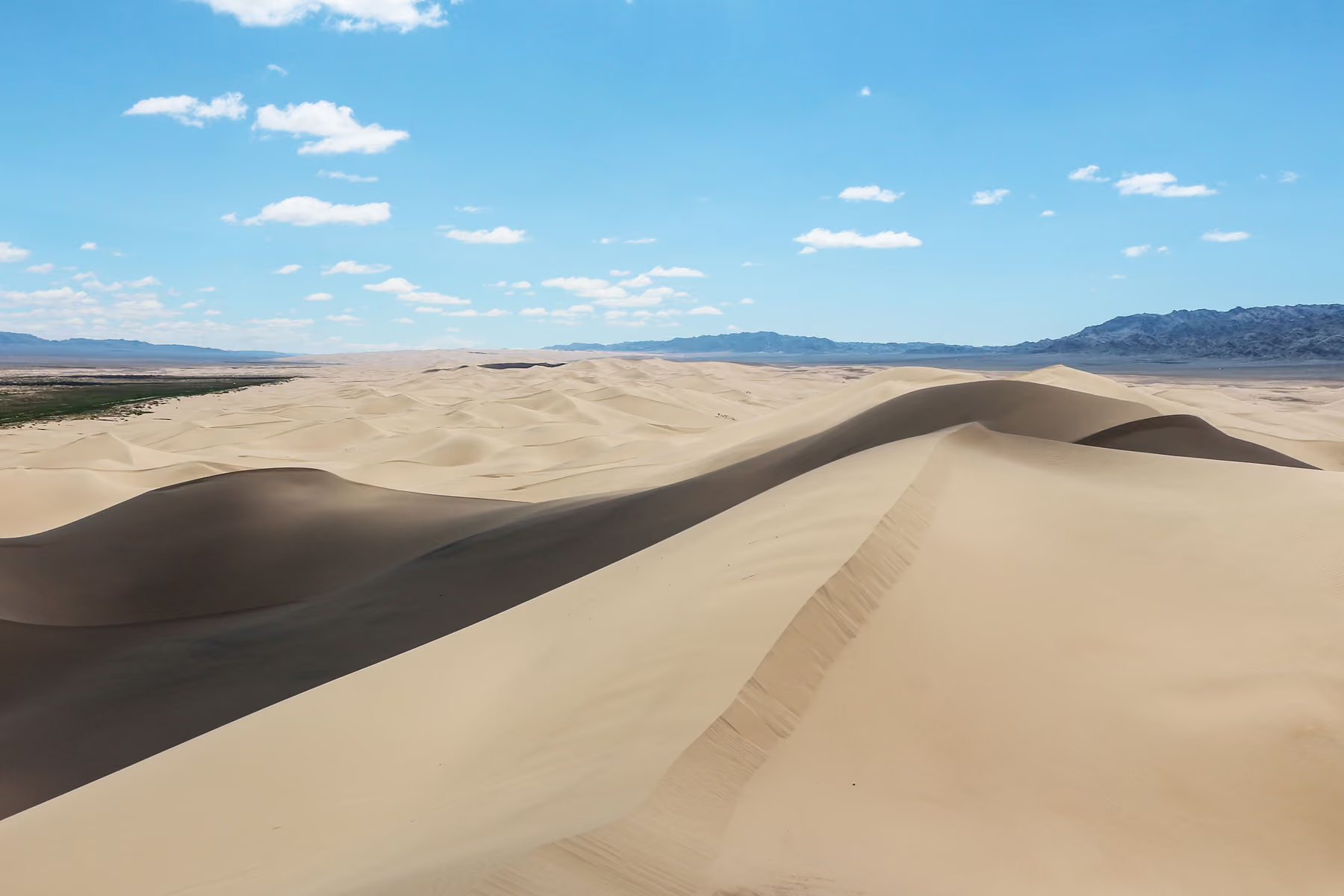
The crest is where the two faces meet. On one side the slope is long and shallow, because that is the angle at which wind can push grains up. On the other it is short and steep, at the angle at which dry sand stops sliding.
That angle is a property of the material rather than of the place. It is close to the same in the Gobi, in the Sahara and in a sandpit.
What differs between dune fields is supply and wind. Where sand is plentiful and the wind blows mostly one way, dunes form long parallel ridges. Where the wind turns with the season, they form stars with several arms.
The photograph is taken along the crest rather than across it, which is the only viewpoint from which the ridge reads as a line instead of a lump. From any other angle this is a hill.
There is no scale in the frame. That is a fair representation of the experience: in a dune field, with no vegetation and no structures, a person cannot tell a two-metre ridge from a two-hundred-metre one until they start walking.