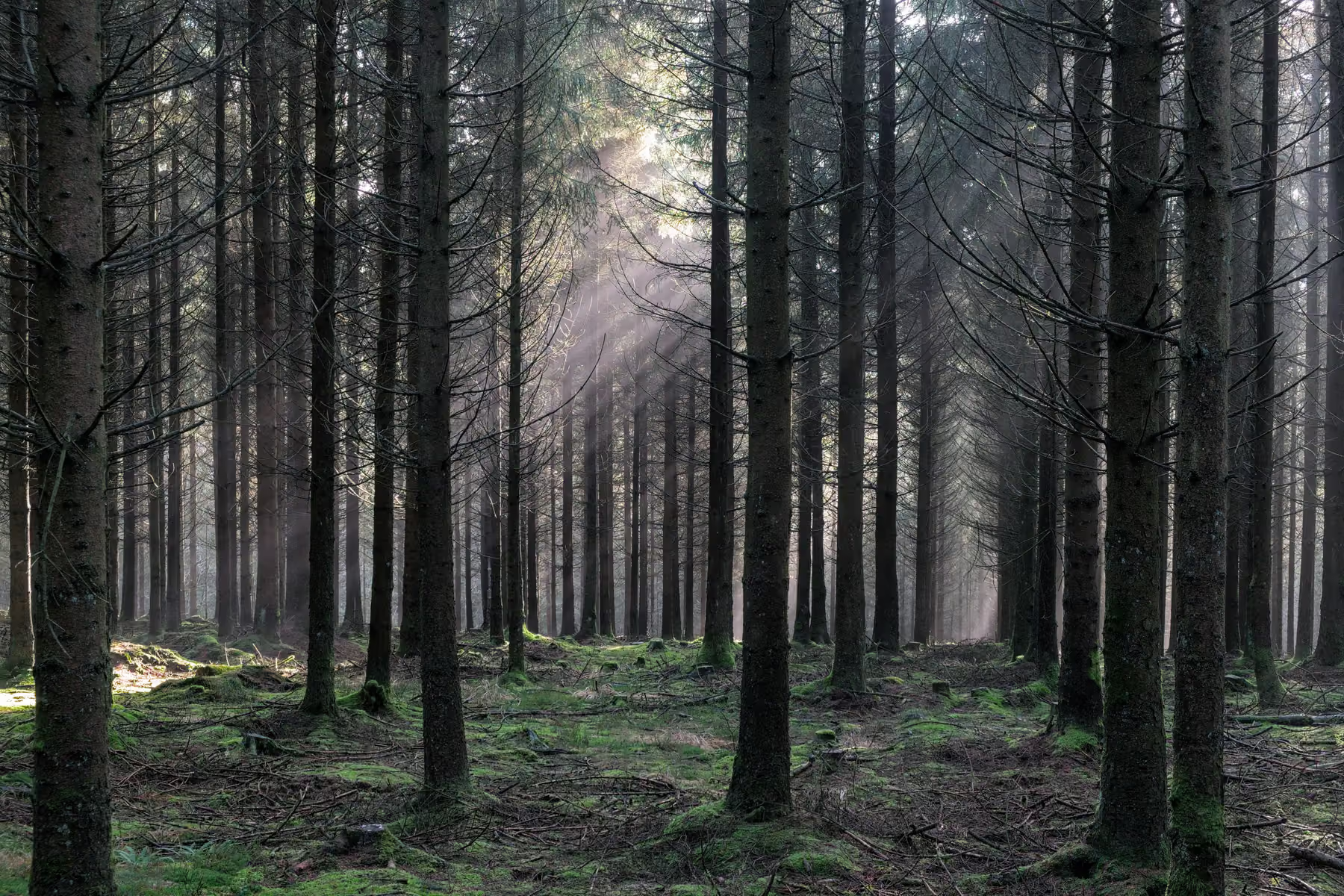
The trunks are evenly spaced, of similar diameter, and clear of branches for most of their height. None of that happens on its own.
Even spacing means the stand was planted rather than seeded. Similar diameter means it was planted at one time, so the trees are the same age and have competed with each other on equal terms. The absence of low branches means the canopy closed early and the lower limbs died from shade, which is exactly what a forester plants densely to achieve: a long clean stem with no knots in the useful part of it.
The light in the frame is a December effect. With the sun low, beams enter a stand from the side rather than from overhead, and they pick out the columns instead of the floor.
What the picture does not show is the ground layer, because there is barely one. A closed conifer plantation is dark at the floor for most of the year, and the litter is slow to break down. Nature parks that contain plantations of this kind usually manage them toward something more mixed, which is a decision measured in decades.