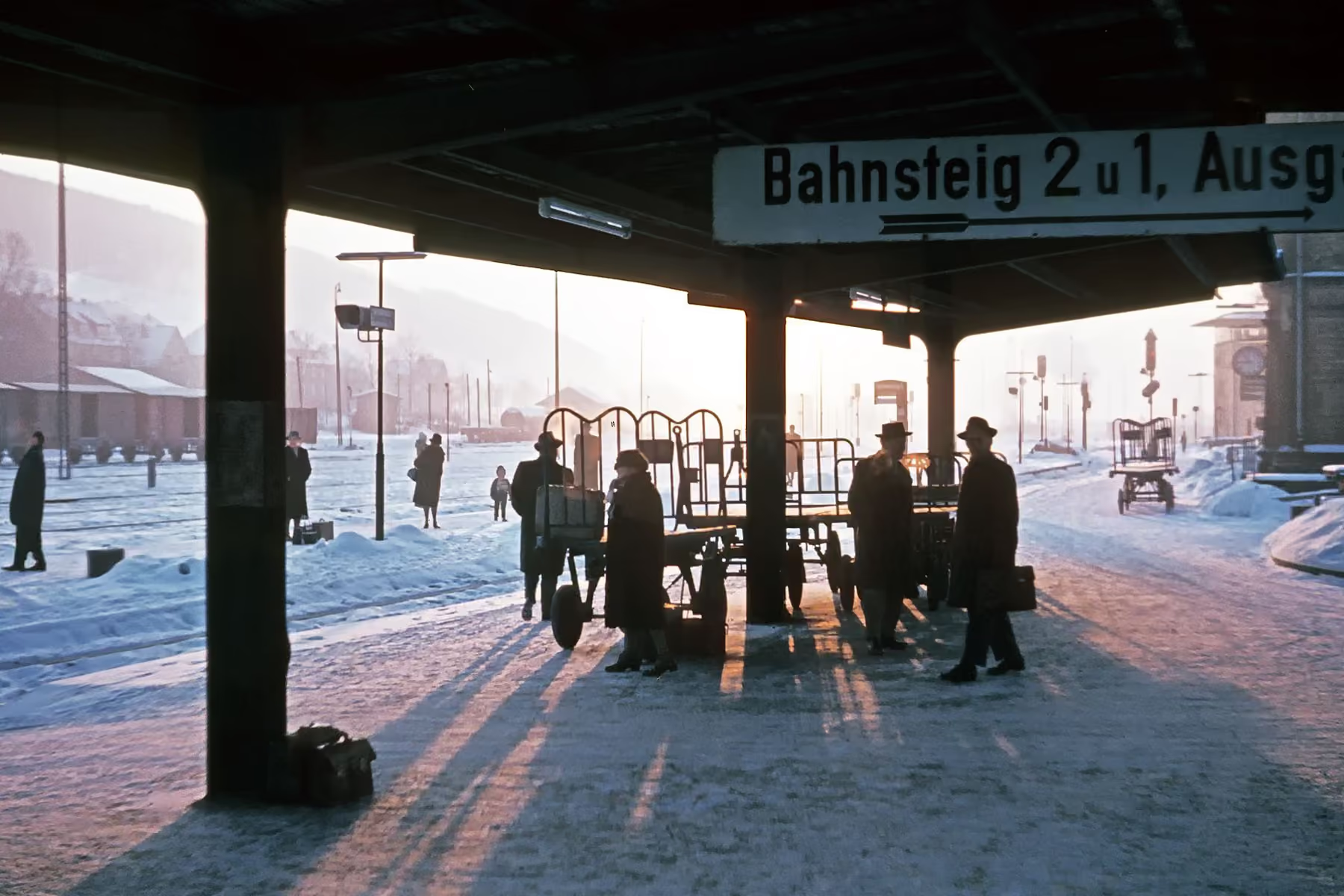
The sign says Bahnsteig 2 u. 1 — platforms 2 and 1 — and points to the stairs. It is the most ordinary object in the frame and the one that dates it most precisely: hand-set lettering on an enamelled plate, hung where a passenger coming up from the subway would meet it at eye height.
A junction is measured not by how many people it serves but by how long it holds them.
Everything else in the picture is snow, canopy and waiting. The passengers stand in the middle of the platform rather than at either end, which is where people stand when they do not yet know which part of the train will be theirs.
What a junction is for
A junction station exists because two lines meet, not because a town needs a station. Its traffic is largely people who arrive and leave on rails without ever walking out of the front door, and its facilities reflect that: shelter, a clock, a subway between platforms, and not much else.
That makes junctions unusually honest buildings. Nothing about them is trying to attract anyone. They are sized to the interval between two connecting services, which is why the canopy is long and the building behind it is small.
The photograph is dated January 1963 and is published under a Creative Commons licence by the photographer. The caption above repeats what the archive record states and nothing more.
The cold
Snow lies on the platform edge but not on the walking line, which means it had been swept, probably more than once that morning. Someone employed at this station had already been out with a shovel before any of these passengers arrived.
That detail is the one most likely to be invisible to the people in the picture, and it is the reason they are standing where they are.