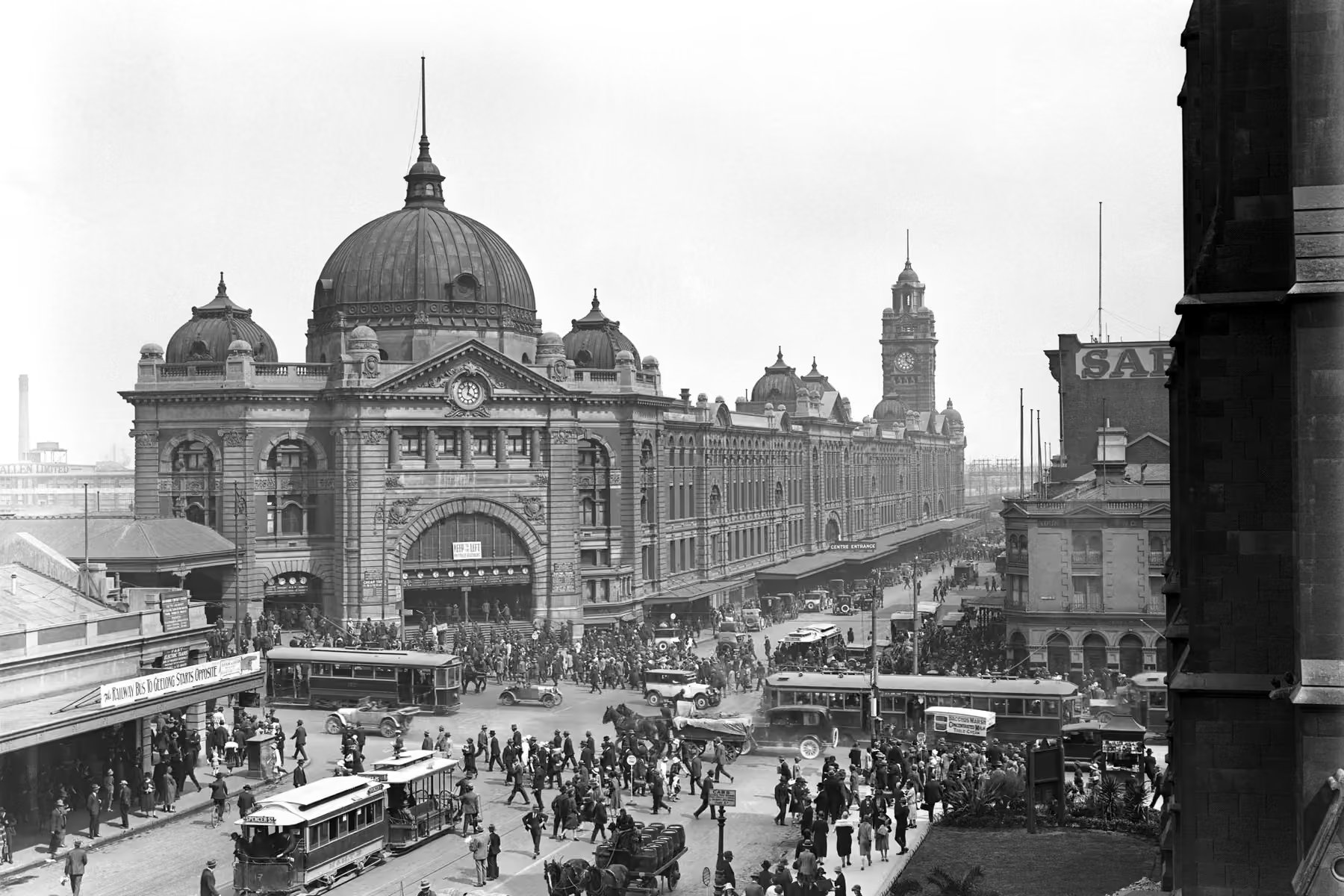
The building is doing two things at once and the photograph catches both. Above the street it is a terminus, with a dome over the entrance and a clock face that a whole city set its watch by. At street level it is a wall with doors in it, and the doors are the reason the intersection looks like this.
Trams, motor traffic, horse-drawn vehicles and pedestrians share the same surface without lane markings. Everyone is negotiating. The photograph was made before traffic signals took that negotiation away, and the result is a crossing with no visible rules and, evidently, a working order.
That order was produced by the timetable behind the wall. A suburban railway discharges its passengers in pulses rather than in a steady stream, and the crowd on the crossing is the shape of a train that has just arrived.
Look at the distribution of people rather than the vehicles. They are not spread evenly across the intersection. They are moving as a front, away from one set of doors, which is what a platform empties like.
The dome is the part everyone remembers and the least important part of the picture. What the building is actually for is under it, out of frame, where several platforms are filling again for the next pulse.