A railway can climb about as steeply as its wheels can hold, and steel on steel holds badly. Where a road would simply tilt upward, a railway has to buy height by buying distance.
The usual way to buy it is a spiral inside a mountain: the line enters a tunnel, turns through a circle in the rock, and comes out above or below where it went in. The passenger sees darkness and then a different view, and the geometry stays private.
Doing it outside
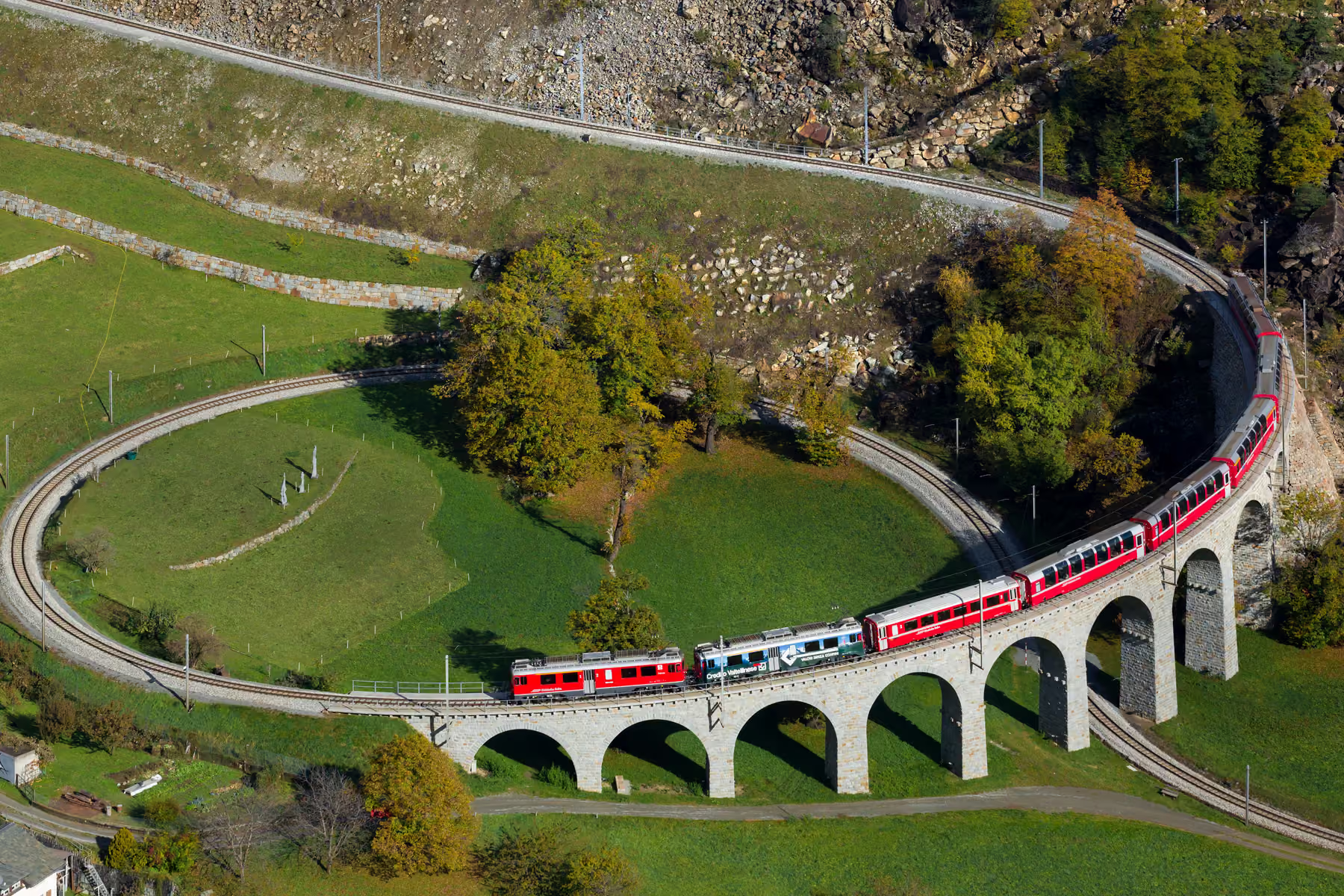
At Brusio the circle is on the surface. The line comes down the hillside, crosses a curved stone viaduct, passes under itself, and continues at a level it could not otherwise have reached without a much longer detour.
The reason is topography rather than showmanship. There was open ground with the right radius available, and a masonry viaduct on that ground was cheaper and simpler to maintain than boring a helix through the hill behind it.
Why it photographs well
A structure is easy to photograph when the eye can see the whole of its logic at once. The spiral at Brusio is legible from a single vantage: you can see the line arrive high, the circle, and the line leave low, in one frame.
That is rare. Most railway engineering is either buried or so long that no viewpoint contains it. A viaduct that explains itself is a gift to a photographer, which is why the same curve appears in so many pictures taken from so many angles.
The train is the scale
Without a train on it the viaduct reads as an oddly shaped garden wall. With one, the radius becomes obvious, and so does the gradient: the leading cars are visibly lower than the ones still on the approach.
This is the ordinary function of rolling stock in an engineering photograph. It is not the subject. It is the ruler.