A storage hydro scheme holds water back behind a dam and releases it when electricity is wanted. A run-of-river scheme does almost the opposite: it takes the flow as it arrives, raises it by a few metres, and generates whatever that flow and that head will give.
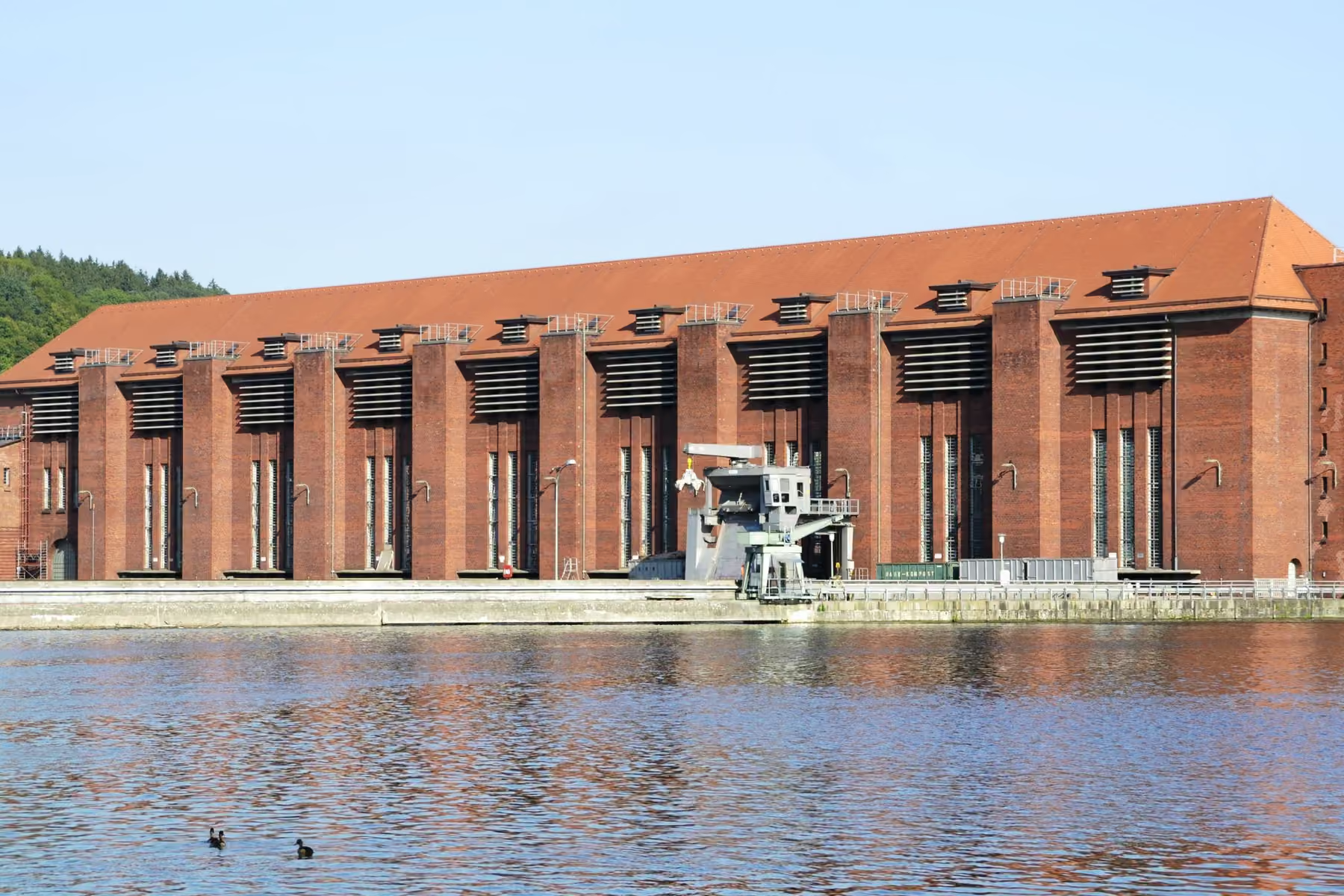
The consequence is architectural. Storage plants are tall, because the head is tall. Run-of-river plants are long, because the head is small and the only way to make power out of a small head is to put a great deal of water through a great many machines.
Why the building is a line
Each generating unit needs its own passage for water — intake, turbine, draft tube — and those passages sit side by side across the river. The hall above them is simply a roof over the row.
That is why the powerhouse reads as a repeated bay rather than as a building with a front door. The rhythm of the windows is the rhythm of the machines.
The weir is the other half
Out of frame, the same structure continues as a weir. The two are one object: the weir makes the head, the powerhouse uses it, and in flood the weir gates open and the plant gives the river its channel back.
A photograph of the powerhouse alone always leaves out the reason it works.