Electricity is moved at high voltage because the losses in a line fall as the voltage rises. That is the entire reason transmission looks the way it does: the pylons, the spacing, the ceramics.
The limit is not the conductor. It is the air around it. Above a certain field strength the air itself starts to conduct, and the design problem becomes how to keep energised metal far enough from everything else — including from other parts of the same machine.
Reading the bushings
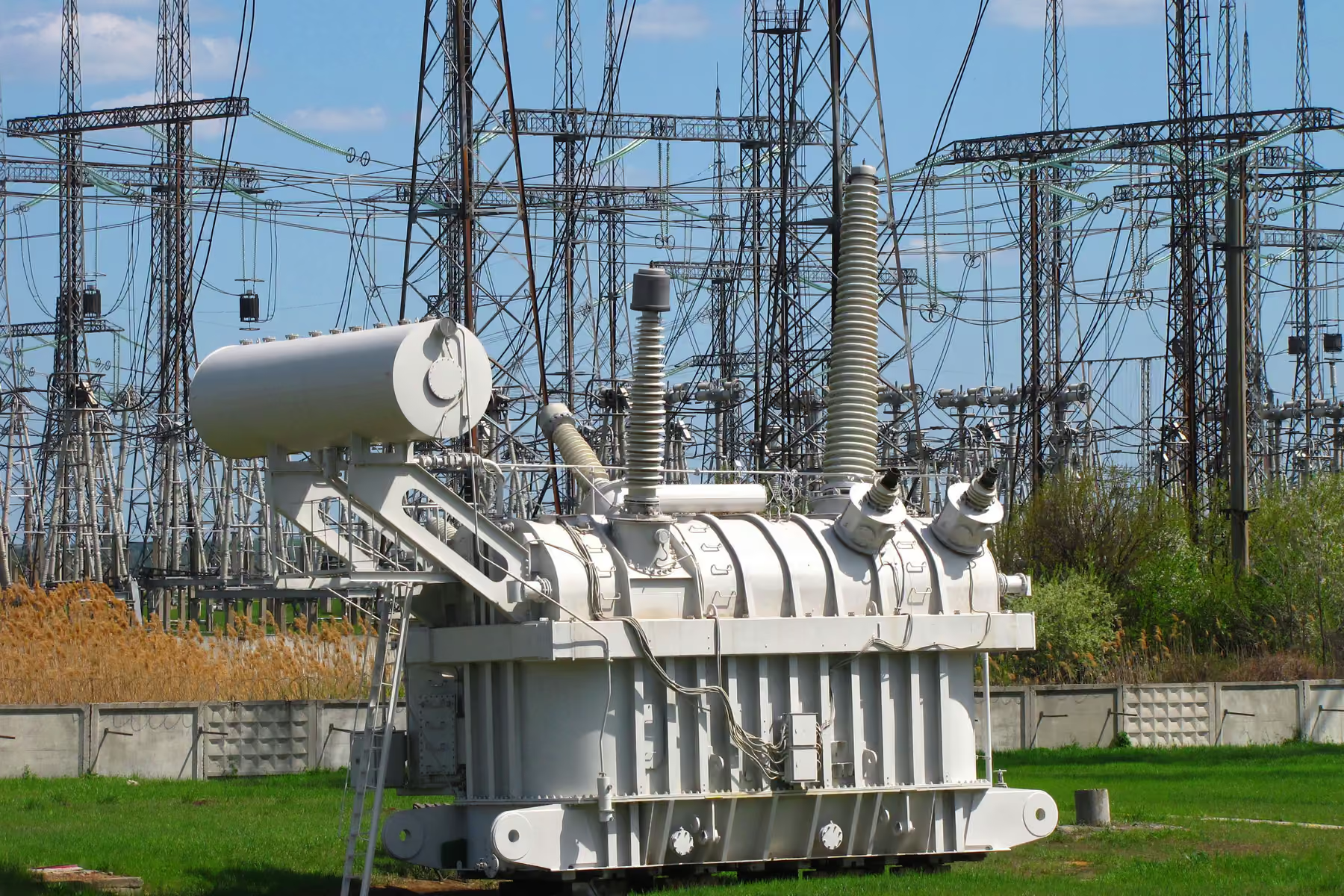
The tall porcelain stacks rising from the tank are bushings: the points where the conductor passes out of the oil-filled body into open air. Their height and the number of sheds along them are set by the voltage and by the local weather, because rain, salt and industrial dust all shorten the effective path.
Count the sheds and you are reading a rating. At 750 kV the stacks are tall enough to dominate the machine underneath them, which is why an extra-high-voltage transformer photographs as a forest of porcelain rather than as a box.
The grass
Nothing is paved. Switchyards are usually surfaced with crushed stone rather than concrete, because stone drains, does not crack, and keeps step potential down if a fault puts current into the ground.
Here the equipment sits in open grass, which reads as neglect and is not. A substation is mostly empty space by design, and the emptiness is part of the insulation.