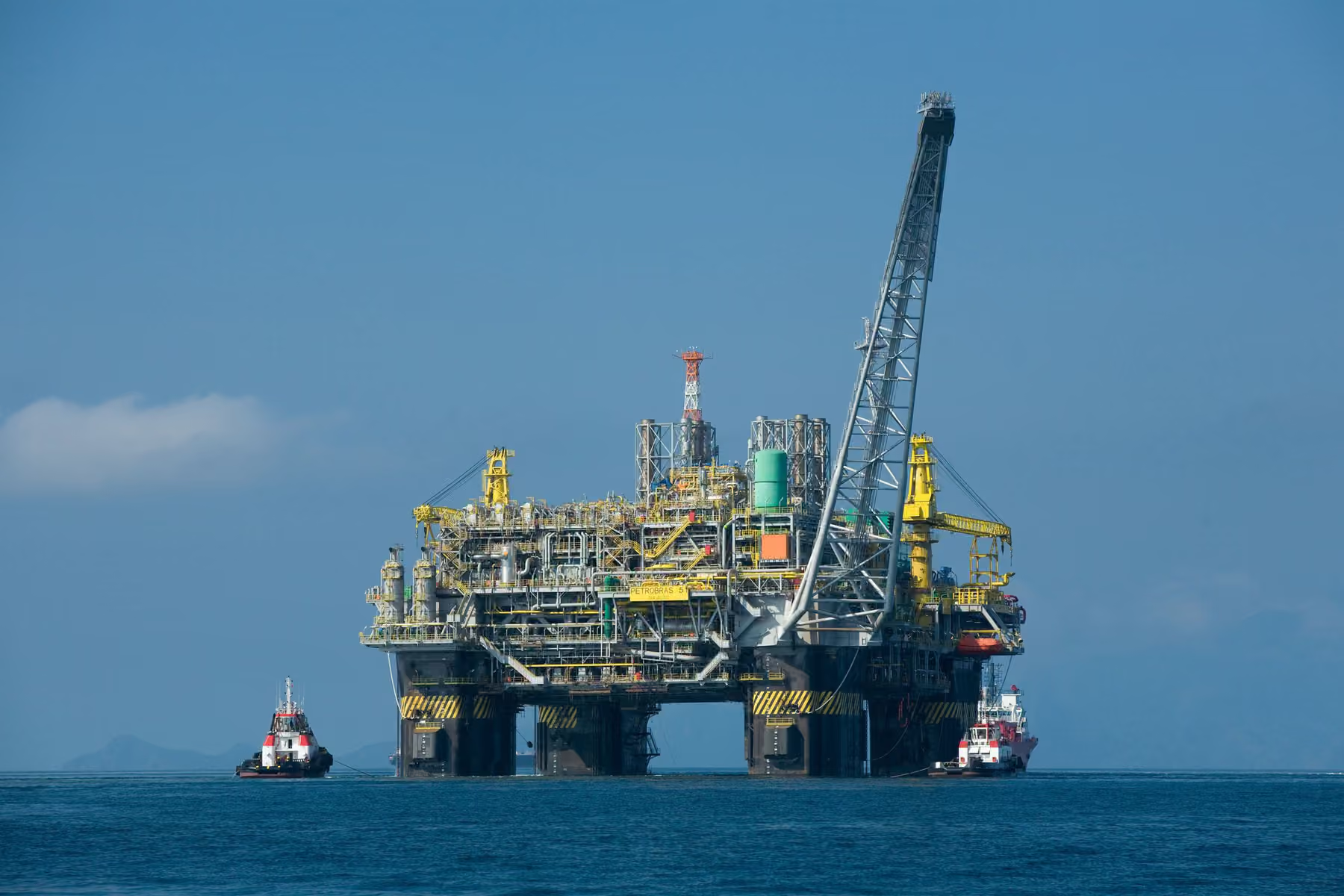
A production platform is a factory that floats. It separates oil, gas and water, treats each one, and sends the product away by pipeline or by shuttle tanker. The hull underneath is there to keep the factory at a workable attitude in a sea that does not cooperate.
Building one is usually an international exercise. Hulls are fabricated in one country, topside modules in another, and the pieces meet at an integration yard for a few months of very expensive lifting.
The claim in the name
What made P-51 notable was not its size but its address. Its operator presented it as the first such platform built entirely in Brazil — hull, modules and integration — which turns a procurement decision into industrial policy.
That claim is worth reading carefully. “Built entirely in” a country almost never means every component was made there; it means the fabrication and integration work, and the wages that go with them, stayed inside the border.
What the photograph shows
The platform is under tow, surrounded by support vessels, at the stage between the yard and the field. Nothing on board is producing anything yet.
It is the only moment in a platform’s life when it is photographed whole from the outside. Once it is on station, it is a structure people arrive at by helicopter, and the pictures are all of details.